
What Happens After a Return Is Inspected? Understanding Disposition
What Happens After a Return Is Inspected? Understanding Disposition
4 MINS READ


Every returned product eventually requires the same decision: What should happen next?
Returns teams make that decision every day, yet many brands don’t have a common term for the process itself. That decision is called disposition.
The word may not be part of every returns team’s vocabulary today, but we think it should be. As returns become more strategic and brands expand into resale, repair, and other recovery channels, disposition becomes one of the biggest opportunities to improve recovery outcomes.
What Is Disposition?
Disposition is the decision that determines a returned product’s next outcome, such as return to stock, resale, repair, refurbishment, liquidation, recycling or another recovery path
Sometimes “disposition” refers to the decision-making process (“We need to determine the disposition.”). Other times it refers to the outcome itself (“The disposition is resale.”). Both usages describe the same thing: deciding the highest-value next step for a returned product.
Disposition Matters Because it Impacts Recovery
Giving this decision a name is only the beginning. Managing disposition as its own operational process creates several advantages:
- Higher recovery value. Every disposition decision affects how much value a brand ultimately recovers from a returned product.
- Opportunity to optimize decisions. Once disposition is treated as its own process, brands can measure outcomes, refine business rules, and improve over time.
- A shared language across teams. A shared term helps returns, operations, and reverse logistics teams align on workflows, business rules, and performance.
The Difference Between Basic and Advanced Disposition Strategies
Most brands have disposition rules, whether they call them that or not. The difference is how sophisticated those rules become as the business evolves.
Imagine two apparel brands processing the same returned jacket.
Brand One
The jacket is inspected and graded Excellent. The brand follows a simple set of rules:
- Excellent condition: Return to stock
- Good condition: Liquidate
- Fair or poor condition: Recycle
The process is straightforward and easy to execute. But it assumes that product condition alone determines the best next step.
Brand Two
The jacket is also graded Excellent. But that’s only the starting point.
Before deciding what happens next, the brand also considers:
- How much inventory is already available
- Whether the item is in season
- How similar products are performing through resale
- Whether a minor repair could increase recovery value
- Which recovery channel will generate the highest return
In September, the jacket may be returned to stock to meet seasonal demand. By February, that same jacket might be routed to the brand’s resale program instead. A minor cosmetic defect could even make repair the highest-value option.
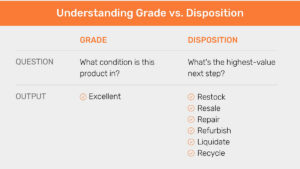
In these examples, the grade is the same. But the disposition is different.
Grading answers ‘what condition is this product in?’ Disposition answers ‘what’s the highest-value next step?’ The same grade can lead to different dispositions, which is why improving grading alone doesn’t optimize recovery.
A Better Way to Think About Returns
As returns become more strategic, disposition becomes more than just a logistics term. It becomes a way for brands to think about, measure, and improve one of the most important decisions in the reverse supply chain. The brands that recover the most value don’t rely on the same disposition rules forever, they refine them as products, channels, and customer demand change. Over time, those refinements add up to better recovery outcomes.
Building a Smarter Disposition Strategy
Disposition is only as strong as the returns process behind it. Learn how Trove’s Returns Management Platform helps brands support multiple recovery paths, automate business rules, and improve recovery outcomes. Learn more.
Your Returns Questions, Answered
What is disposition in returns management?
Disposition is the decision about what happens to a returned product after inspection. Depending on the product and business rules, it may be returned to stock, resold, repaired, refurbished, liquidated, recycled, or routed to another recovery path.
How can brands improve their disposition strategy?
Brands improve disposition by looking beyond product condition. Factors like inventory levels, seasonality, resale demand, and recovery value help determine the highest-value next step. Regularly reviewing outcomes also helps optimize business rules over time.
What’s the difference between grading and disposition?
Grading identifies a product’s condition. Disposition determines its next step. Two products with the same grade may have different dispositions based on inventory, demand, or recovery opportunities. Grading provides the input; disposition drives the decision.