
How to Reduce Operator Variance in Returns Processing
How to Reduce Operator Variance in Returns Processing
5 MINS READ


The fate of every returned product rests in the hands of the warehouse associates assessing its condition, assigning its grade, and deciding where it goes next.
The same product can get a different decision (or take longer to process) depending on the associate handling it. That variance drives up processing costs and can affect recovery and the customer experience, especially as new and seasonal labor ramps up.
Reducing operator variance means making the right decision easier, regardless of who’s working the station.
The Metrics That Matter for Returns Operators
Returns workforce performance is difficult to capture in a single metric. Throughput and labor cost show how efficiently work gets done, but they don’t capture the quality of the decisions behind it. A fast associate who misgrades sellable inventory can look productive on paper, while the impact shows up later in lower recovery.
A better measure of workforce performance balances speed, decision quality, and recovery, connecting labor efficiency to inventory outcome, such as:
- Speed: Units processed per hour, labor cost per return, and ramp time for new associates.
- Decision quality: Inspection and grading accuracy, consistency across operators, and exception handling.
- Recovery: Return-to-stock rates, disposition outcomes, and recovery value.
Together, these metrics show not only how quickly work gets done, but how effectively operator decisions translate into recovery value.
3 Steps to Reduce Operator Variance in Your Own Facilities
1. Find Variance at the Decision Level
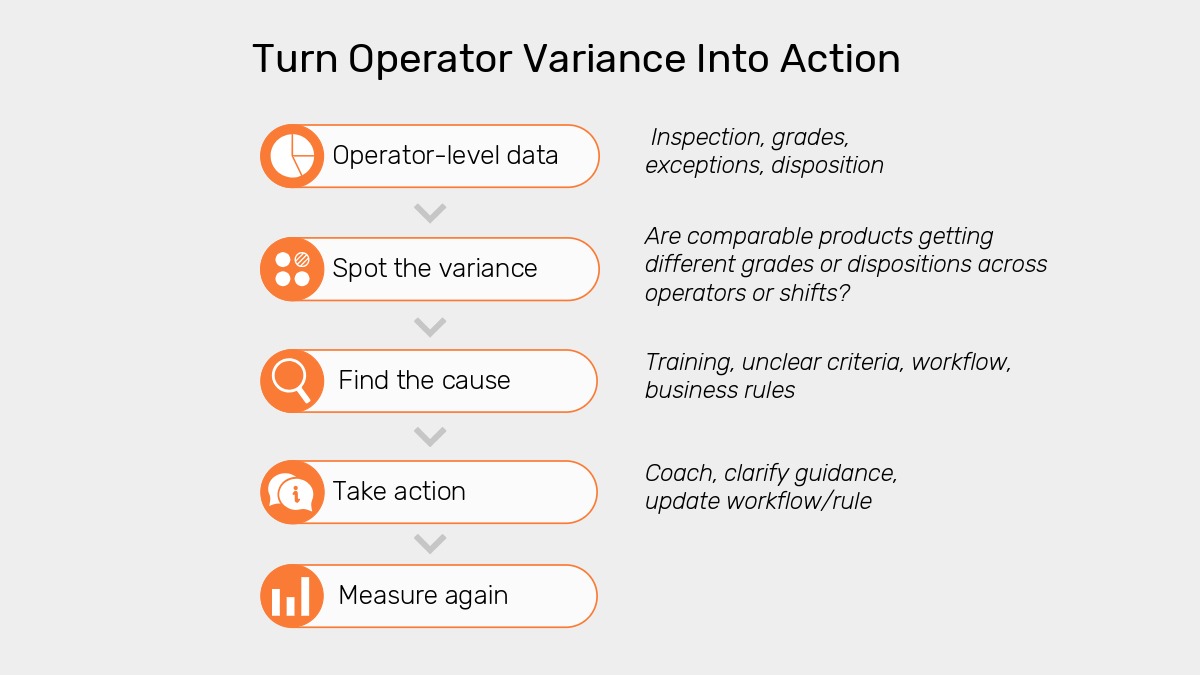
Don’t just compare overall throughput or recovery by operator. Compare the specific decisions that produce those outcomes: inspection responses, defect identification, grades, exception rates, and disposition. If one operator returns 80% of a SKU to stock while another returns 60%, trace the difference back through those decision points to see where their paths diverge.
2. Separate Operator Problems From Process Problems
Once you find a divergence, look at how widely it occurs. If one associate consistently grades a product differently from peers, coaching may be the answer. If operators across a shift or facility make the same mistake, look upstream at the inspection question, grading criteria, product information, or workflow. The pattern of variance helps tell you what needs fixing.
3. Remove Judgment Where a Rule Can Make the Decision
Not every returns decision needs operator interpretation. Identify repeatable decisions that can be driven by product attributes, inspection responses, inventory conditions, or business rules and build that logic into the workflow. Reserve operator judgment for true exceptions.
Regardless of whether your team works primarily in a WMS, ERP, or another system, you should be able to see where operator decisions vary. An RMS can capture returns-specific data like inspection responses, grades, exceptions, and disposition outcomes, then integrate those insights into the systems you already use. That gives teams the detail needed to spot variance and act on it without creating another data silo.
How to Reduce Operator Variance When Your 3PL Manages Returns
When returns are outsourced, operator variance can be harder to see. The associates work for your 3PL, but their decisions still affect your inventory, recovery, and brand.
- Get More Granular Performance Data. Facility averages can obscure operator variance. Make sure your 3PL breaks down performance by shift, workflow, and product category. Watch for patterns like one shift taking longer with the same product mix or sending more comparable inventory to non-new dispositions. Your reporting should also reveal where grading variance, exceptions, and rework are highest.
- Turn Brand Standards Into Operator-Level Guidance. Work with your 3PL to translate brand standards into specific inspection questions, grading thresholds, and disposition rules within the workflow. Define, for example, what level of wear changes a grade or which defects trigger an exception. Clear criteria reduce interpretation at the point of decision.
- Create a Feedback Loop Around Variance. Agree on how recurring variance will be investigated and resolved. Trace patterns like high exception rates or low return-to-stock rates back to the operator, criteria, or workflow. Then determine whether the fix is coaching, clearer guidance, or a rule change, and measure whether it improves the outcome.
Better Decisions Start With Better Systems
Returns will always require some human judgment, but using technology like a returns management system can reduce variance with guided inspection, grading, and disposition while sharing operator-level performance data across users. This supports:
- Guided decisions: Give operators relevant criteria at each step
- Variance visibility: Identify where outcomes differ.
- Consistent execution: Apply rules across teams and facilities.
- Faster onboarding: Help new associates make good decisions sooner.
- Easier updates: Change requirements centrally as processes evolve.
Make the right returns decision easier to make.
See how Trove’s Returns Management System brings inspection criteria, grading rules, and disposition logic directly to the facility floor, helping operators make faster, more consistent decisions regardless of experience level. Learn more here.
Your Returns Questions, Answered
What is operator variance in returns processing?
Operator variance occurs when comparable returns are inspected, graded, or dispositioned differently depending on who processes them. This can lead to inconsistent outcomes and lost recovery value.
How can brands reduce operator variance in returns processing?
Brands can reduce variance by identifying where decisions diverge, addressing unclear criteria or training gaps, and using guided workflows and business rules to standardize repeatable decisions.
How can brands measure operator performance when a 3PL manages returns?
Brands can work with their 3PL to track performance by shift, workflow, and product category. Grading variance, exceptions, disposition outcomes, and return-to-stock rates can reveal where decisions differ.