
Four Questions to Evaluate Your 3PL’s Returns Recovery Capabilities
Four Questions to Evaluate Your 3PL’s Returns Recovery Capabilities
4 MINS READ


For many brands, 3PL performance comes down to a familiar set of metrics: speed, accuracy, cost, and SLA performance. Those numbers matter, but they don’t tell the full story of how much value the returns operation is recovering from returned inventory.
A return can be processed quickly and still end up in the wrong recovery channel. An item can pass inspection while valuable product-level data goes uncaptured. And a 3PL can meet every SLA without identifying opportunities to improve recovery over time.
For operations leaders, that makes the question bigger than ‘how efficiently are our returns being processed?’ It’s also, ‘are we getting the most value from the inventory that comes back?’
Here are four questions to help you understand whether your 3PL is maximizing recovery:
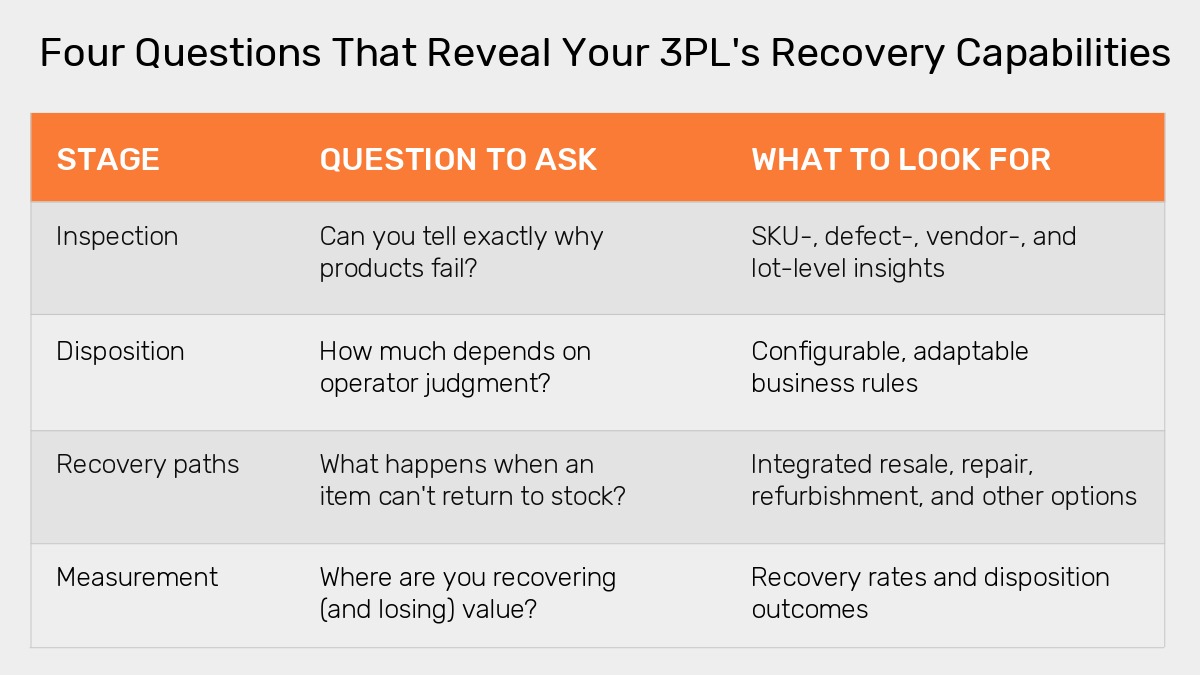
1. Can You Tell Us Exactly Why Products Fail Inspection?
A grade or pass/fail result only tells you so much. Detailed inspection data can reveal why products fail and whether those failures follow a pattern. Ask your 3PL if they can identify recurring defects by SKU, flaw, vendor, or production lot. Or, if they can see whether a particular component is failing more often. That level of detail allows your team to address problems beyond the returns operation, from supplier performance to product quality.
2. How Much of Disposition Depends on Operator Judgment?
Once an item is inspected, the next critical decision is disposition: where should that inventory go? Ask how much of that decision is driven by predefined business rules versus individual operator judgment. Manual inspection and judgment calls can introduce inconsistencies that cause sellable inventory to miss the return-to-stock path, lowering recovery rates. Rules-based disposition can create more consistent outcomes and give brands greater control over how inventory is routed.
Just as important, those rules should be adaptable. Changes in inventory levels, seasonality, resale demand, or recovery economics may all change the best next step for a product.
3. What Happens to Products That Can’t Immediately Return to Stock?
Return-to-stock may be the preferred outcome, but it won’t be the right destination for every item. Find out what happens when a product isn’t eligible for immediate restock. Can it move into resale, repair, refurbishment, liquidation, or another recovery channel? Are those options integrated into the returns workflow or handled through separate manual processes? The right mix of recovery paths gives brands more opportunities to route each item toward its highest-value outcome rather than defaulting to liquidation or write-off.
4. How Are We Recovering Value and Where Are We Losing It?
Operational reporting tells you how returns are moving. Recovery reporting tells you whether those movements are creating value. Look for visibility into recovery rates, disposition outcomes, and recovery value across products, categories, conditions, and channels. That data can reveal not only where inventory is being lost, but where routing decisions are leaving margin on the table.
Asking more of your 3PL starts with asking better questions
A returns operation can hit every processing target and still leave recovery value on the table. Looking at inspection findings, disposition decisions, recovery paths, and outcomes gives brands a clearer picture of how effectively returned inventory is being managed. The strongest 3PL relationships don’t just report what happened. They use inspection and recovery data to continually refine workflows, disposition rules, and recovery strategies.
Get more value from every return. See how Trove helps brands and 3PLs improve return-to-stock performance, automate disposition decisions, and route more inventory toward higher-value recovery channels. Talk to us today.
Your Returns Questions, Answered
What should brands measure when evaluating a 3PL’s returns performance?
Brands should look beyond processing speed, accuracy, and SLAs to evaluate inspection quality, disposition outcomes, recovery rates, and how much value is recovered from returned inventory.
How can a 3PL improve return-to-stock rates?
Detailed inspection workflows and consistent, rules-based decisioning can help identify more sellable products and route eligible inventory back to stock instead of lower-value recovery channels.
How can brands recover more value from returned inventory?
Brands can improve recovery by using detailed inspection data, adaptable disposition rules, and multiple recovery paths such as restock, resale, repair, refurbishment, and liquidation.
What returns data should a 3PL provide to brands?
A 3PL should provide visibility into inspection findings, recovery rates, and disposition outcomes across products, categories, conditions, and recovery channels.